The Basking Shark (Cetorhinus maximus) is the second-largest living fish on Earth, exceeded in size only by the whale shark. Reaching lengths of up to 10 metres and weighing up to 5 tonnes, these magnificent, slow-moving creatures are a true icon of Scotland’s wild seas.
Despite their imposing size, Basking Sharks are harmless filter-feeders. Migrating thousands of miles from deep ocean waters each summer, they are drawn to the coastal currents of Wester Ross and the Minch, where sunlit, nutrient-dense surface waters create massive blooms of microscopic plankton.
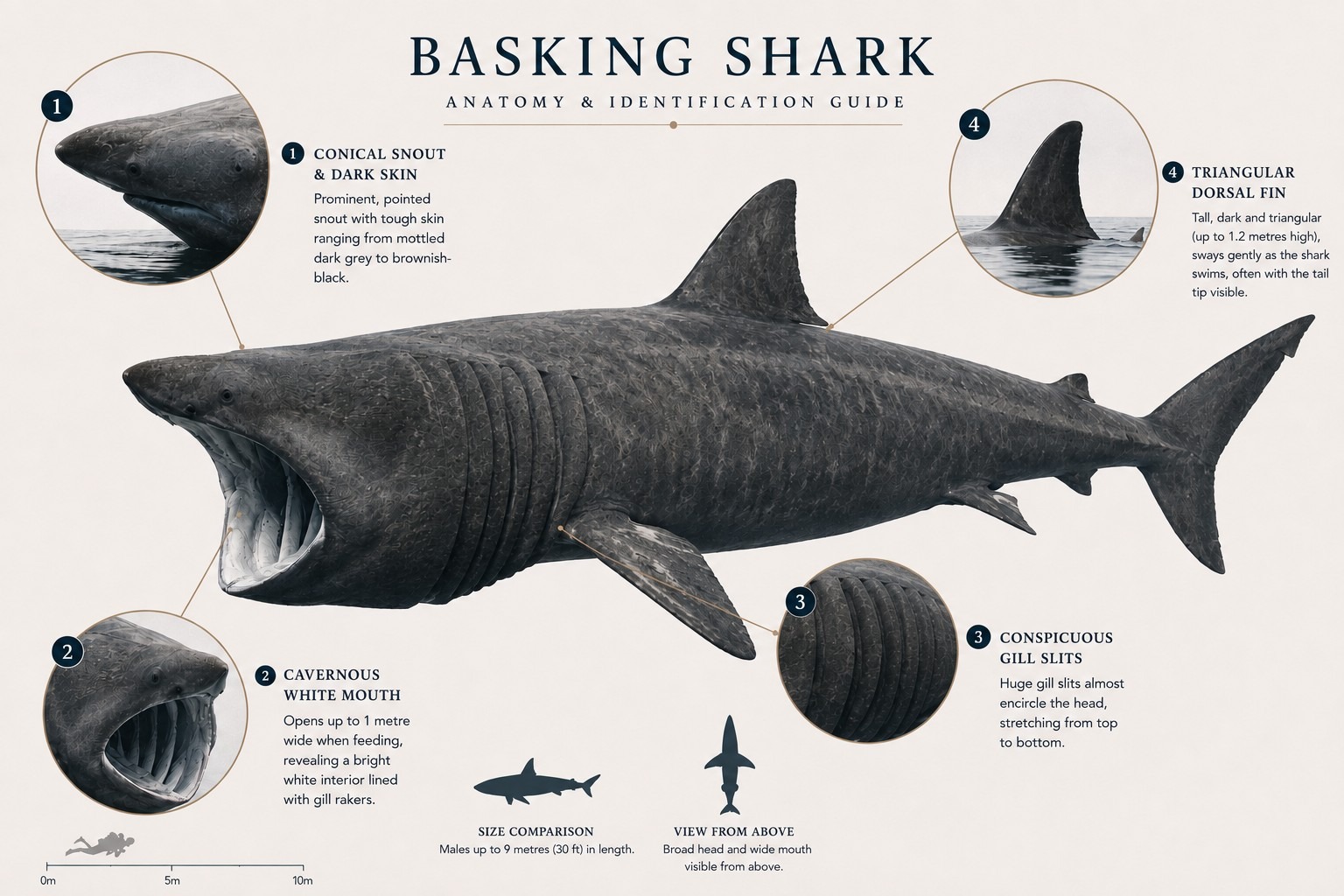
Anatomy & Identification Guide
When scanning the water on calm days, look for these distinctive, highly recognisable traits:
The Triangular Dorsal Fin: A massive, dark triangular dorsal fin (up to 1.2 metres high) that sways gently from side to side as the shark swims, often accompanied by the tip of its tail fin trailing behind.
Cavernous White Mouth: When feeding, Basking Sharks open their mouths up to a metre wide, revealing a bright white interior lined with thousands of bristled gill rakers used to strain plankton.
Conspicuous Gill Slits: Almost completely encircling the head, their huge gill slits stretch from top to bottom, allowing thousands of tonnes of water to pass through every hour.
Conical Snout & Dark Skin: A prominent, pointed snout precedes the head, while their tough skin ranges from mottled dark grey to brownish-black.
Fascinating Behaviours in The Minch
Basking Sharks offer incredible surface displays during the warmer months:
Thermal Sunbathing & Feeding: They get their name from their habit of “basking” lazily near the surface. In reality, they are cruising along thermal fronts at around 2 knots with their mouths wide open, filtering up to 2,000 tonnes of seawater per hour.
Nose-to-Tail Socialising: While often solitary, groups (or “schools”) will gather in rich feeding zones. Observers often spot them swimming in tight, nose-to-tail formations, a behaviour believed to be linked to courtship and social bonding.
Spectacular Breaching: Despite their slow pace, Basking Sharks can launch their entire multi-tonne bodies clear out of the water! Scientists believe this dramatic breaching helps dislodge parasites or signals presence to other sharks nearby.
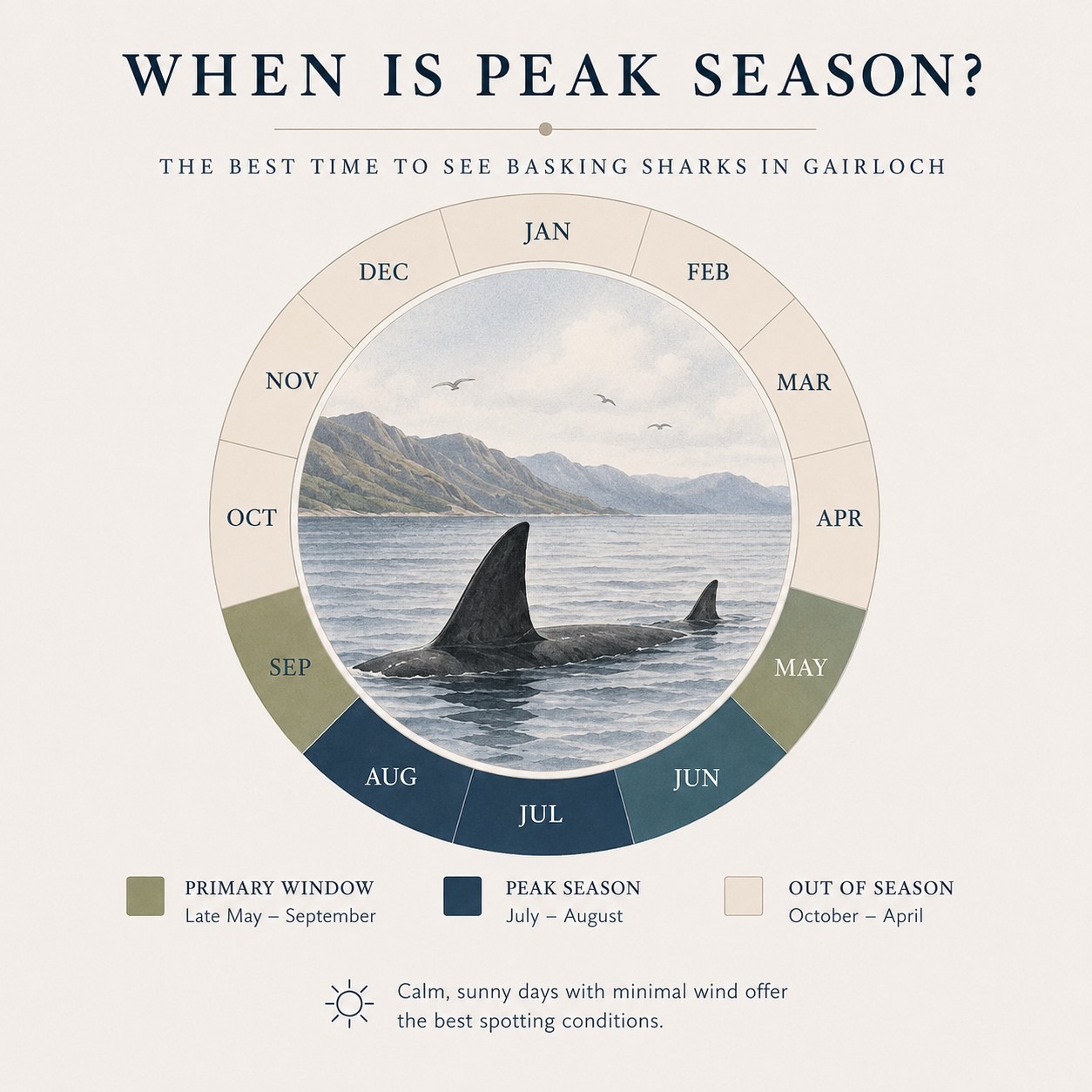
When is Peak Season?
The primary window to encounter Basking Sharks off Gairloch opens in late May and peaks from July through September, aligning perfectly with summer plankton blooms.
Calm, sunny days with minimal wind provide the best spotting conditions, as the lack of surface chop makes their trailing dorsal and tail fins easy to spot from land or boat deck.
The Science: Satellite Tagging & The Sea of the Hebrides
Once mysterious, research by NatureScot and the University of Exeter has shed light on these gentle giants:
Hebridean Sanctuary: Satellite tracking has revealed that the waters of the Inner Hebrides and the Minch are one of the most important summer habitats for Basking Sharks anywhere in the world.
Winter Deep-Diver: Tagging data shows that when Scottish waters cool in autumn, Basking Sharks migrate southwards towards the Canary Islands and North Africa, diving to depths of over 1,000 metres before returning the following spring.
Conservation & Local Stewardship
Historically targeted by commercial fisheries for their liver oil, Basking Sharks are now fully protected under UK law, but face ongoing modern pressures:
Protected Marine Area: The Scottish Government established the Sea of the Hebrides Marine Protected Area (MPA) specifically to safeguard Basking Sharks and Minke whales from habitat degradation and industrial marine disturbance.
Vessel Strike Vulnerability: Because they spend long periods feeding just below the surface, Basking Sharks are particularly vulnerable to boat propeller strikes. Local operators adhere strictly to the Basking Shark Code of Conduct, maintaining slow speeds and neutral gears around active sharks.