The Coastal Guardians & River-Loch Hunters of Wester Ross
An Introduction to Our Coastal Neighbours
While the open waters of the Minch host giant whales and sharks, the rocky shorelines, sea lochs, and kelp beds around Gairloch are the domain of two of Scotland’s most beloved coastal mammals: Seals and Eurasian otters.
Whether observing an inquisitive seal popping its head above the tide or catching a rare glimpse of an otter foraging among the bladderwrack, these species offer exceptional wildlife viewing right where the land meets the sea. Gairloch’s sheltered bays, abundant fish stocks, and undisturbed coastline make our corner of Wester Ross a vital haven for both species year-round.
Anatomy & Identification Guide
Telling our two seal species apart, and spotting an otter along the shoreline, relies on observing key physical traits:
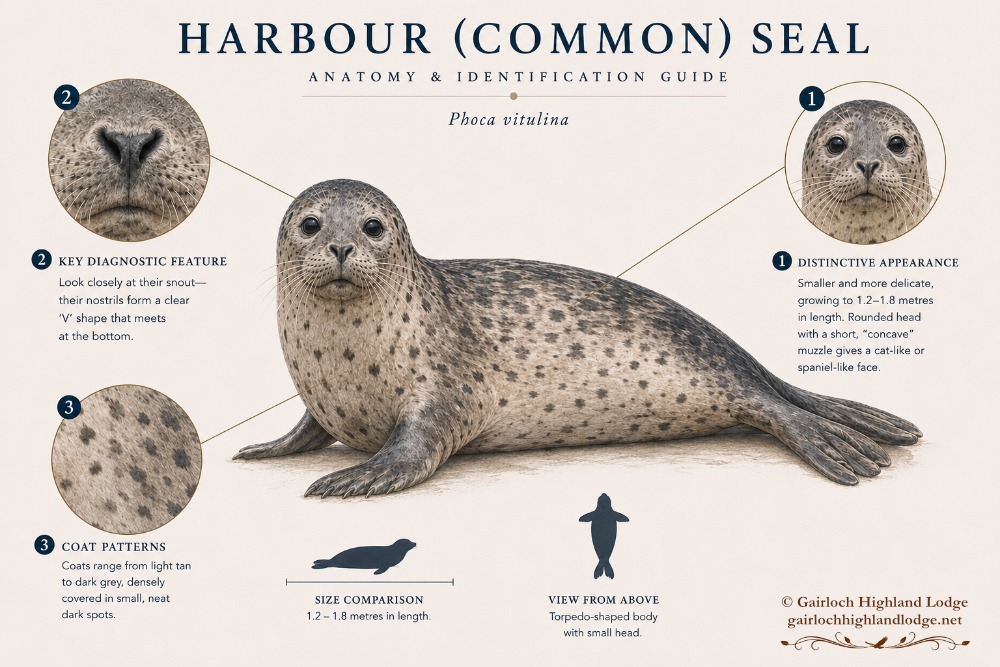
Harbour/Common Seal (Phoca vitulina)
Distinctive Appearance: Smaller and more delicate, growing to 1.2–1.8 metres in length. They feature a rounded head with a short, “concave” muzzle that gives them a distinctly cat-like or spaniel-like face.
Key Diagnostic Feature: Look closely at their snout—their nostrils form a clear ‘V’ shape that meets at the bottom.
Coat Patterns: Their coats range from light tan to dark grey, densely covered in small, neat dark spots.
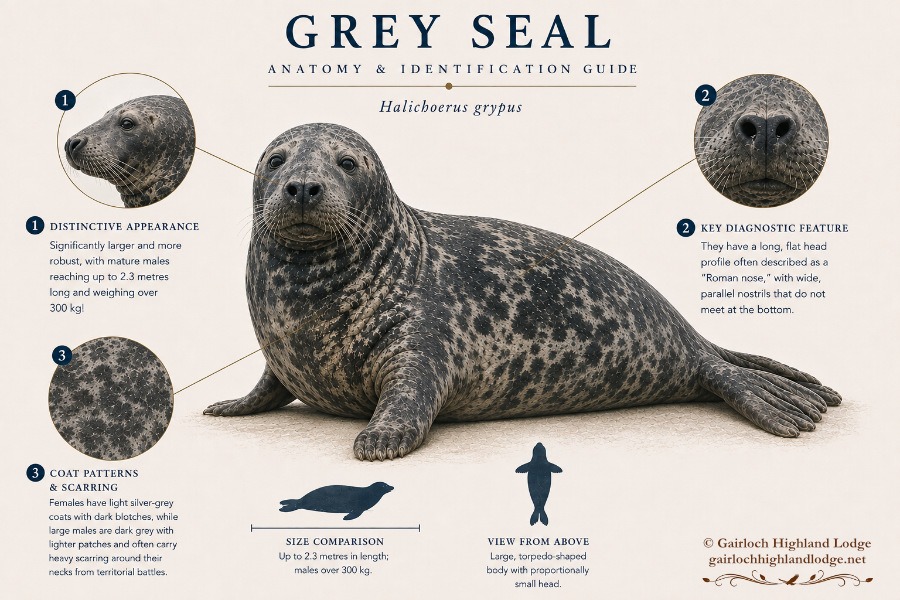
Grey Seal (Halichoerus grypus):
Distinctive Appearance: Significantly larger and more robust, with mature males reaching up to 2.3 metres long and weighing over 300 kg!
Key Diagnostic Feature: They have a long, flat head profile often described as a “Roman nose,” with wide, parallel nostrils that do not meet at the bottom.
What’s in a Name? Their scientific name, Halichoerus grypus, literally translates from Latin and Greek as the “hook-nosed sea pig”. This a very fitting description for the large, broad-faced males!
Coat Patterns & Scarring: Females have light silver-grey coats with dark blotches. While large males are dark grey with lighter patches and often carry heavy scarring around their necks from territorial battles.
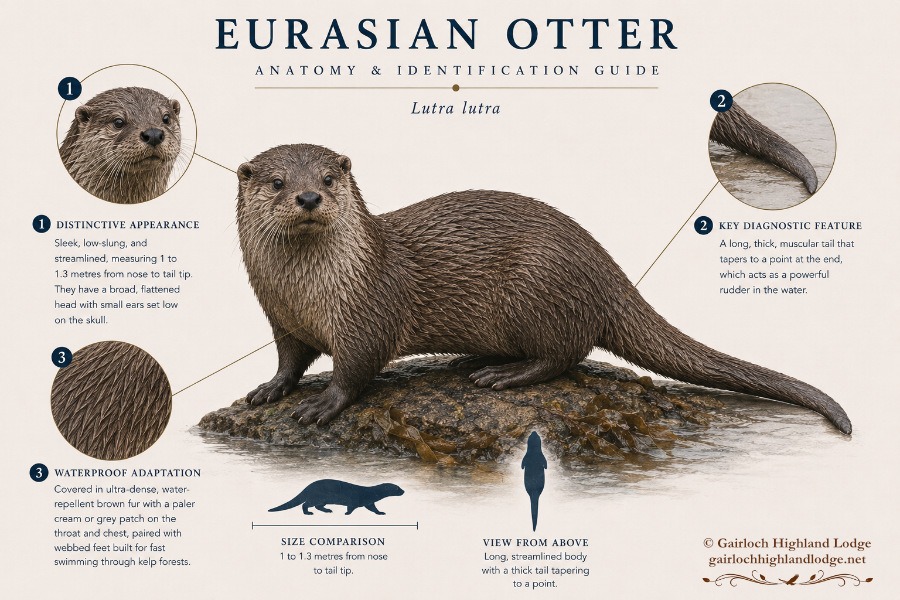
Eurasian Otter (Lutra lutra):
Distinctive Appearance: Sleek, low-slung, and streamlined, measuring 1 to 1.3 metres from nose to tail tip. They have a broad, flattened head with small ears set low on the skull.
Key Diagnostic Feature: A long, thick, muscular tail that tapers to a point at the end, which acts as a powerful rudder in the water.
Waterproof Adaptation: Covered in ultra-dense, water-repellent brown fur with a paler cream or grey patch on the throat and chest, paired with webbed feet built for fast swimming through kelp forests.
Fascinating Behaviours in The Minch
Both seals and otters exhibit captivating daily routines along the Gairloch coast:
Banana-ing & Haul-Outs: Harbour and Grey Seals frequently “haul out” onto exposed rocks and skerry reefs at low tide to rest, digest, and regulate body temperature. They often adopt a “banana pose”—curling their head and hind flippers up into the air off cold rocks.
The “Corkscrew” Seal: When curious about nearby boats or shore-walkers, seals will perform a “bottlenose” or “corkscrew” surface, floating vertically in the water with just their heads exposed to keep a watchful eye.
Otter Hunting & “Sprainting”: Otters dive into kelp forests to hunt for octopus, crabs, butterfish, and sea loch roundfish, usually bringing prey up to flat rocks to eat. They mark their home territories along rocky coastlines using distinctively scented droppings known as “spraint.”
When is Peak Season?
Both seals and otters are resident year-round in Gairloch, but specific months bring unique natural spectacles:
Harbour Seal Pupping (June – July): Females give birth to pups on sheltered skerry rocks. Pups are able to swim within hours of birth!
Grey Seal Pupping (Autumn/October – November): Grey Seals give birth to fluffy white-coated pups on secluded beaches and islands around the Minch.
Otter Spotting (Year-Round): Best observed on a falling tide early in the morning or late in the evening when human activity is low and otters are actively foraging along the tide line.
The Science: Coastal Predators & Marine Monitoring
Scientific research along the West Coast highlights the ecological importance of these shoreline species:
Specialised Whiskers (Vibrissae): A seal’s whiskers are extraordinarily sensitive, capable of detecting the tiny hydrodynamic wakes left by fish swimming in pitch-black or murky waters hundreds of metres away.
Saltwater Adaptations in Otters: Unlike sea otters in the Pacific, Eurasian otters rely on fresh water to clean salt from their fur to maintain its insulating properties. They are constantly moving between the marine sea lochs and freshwater Highland burns.
Top-Level Apex Predators: As key predators in the coastal food web, seals and otters keep local fish, crab, and octopus populations balanced and healthy. Because they sit at the top of the coastal food chain, their overall health is a direct indicator of the cleanliness and fish stocks of our sea lochs.
Photo-ID & Population Monitoring: Marine biologists track individual seals using the unique, spot-and-blotch patterns on their coats—which remain identical throughout their lives. This non-invasive photo-identification allows researchers to monitor local population sizes, pup survival rates, and movement between West Coast haul-out sites.
Conservation & Local Stewardship
As coastal species living at the intersection of land and sea, seals and otters require protected marine and terrestrial environments:
Protected Species: Both Grey and Harbour Seals, as well as Eurasian Otters, receive strict legal protection under UK and Scottish conservation law.
Marine Litter & Entanglement: Discarded fishing gear, plastics, and lost lines pose severe entanglement risks to marine mammals. We encourage all visitors to leave our shorelines cleaner than they found them.
Keep a Safe Distance: When observing seals on skerry reefs or beaches, maintain a distance of at least 50 to 100 metres. If a seal lifts its head, shifts position, or looks repeatedly at you, you are too close—back away slowly.
Never Flush Seals into the Sea: Scaring seals off their rocks into the water causes severe stress, wastes vital energy, and can cause mothers to abandon newborn pups on land.
Dog Safety: Always keep dogs on a short lead along coastal paths, beaches, and near skerry haul-out sites. Unrestrained dogs can cause panic among seal colonies and disturb coastal otter holts.
Paddlers & Boat Craft: Kayakers, paddleboarders, and boat skippers should maintain a wide berth, avoiding heading directly towards haul-outs. Pass quietly and predictably at slow speeds.