An Introduction to Gairloch’s Coastal & Marine Birds
The dramatic coastline of Wester Ross and the nutrient-rich, tide-swept waters of the Minch form one of Europe’s great marine sanctuaries. It is where steep mountain slopes and sheltered sea lochs meet the open Atlantic. Upwelling currents push massive shoals of sand eels, herring, and sprat toward the surface. This seasonal abundance turns the skies and waters around Gairloch into a bustling, high-octane highway for hundreds of thousands of breeding and migrating coastal birds.
Whether you are scanning the calm waters of Loch Gairloch from the shore or setting off on a local wildlife cruise, the sheer variety of birdlife is extraordinary. From majestic apex predators like the White-tailed Sea Eagle soaring over coastal sea cliffs. As well as the comical flurry of puffins beating their wings just above the waves. Gairloch offers a front-row seat to some of the finest birdwatching in the United Kingdom. On local boat trips heading out towards The Shiant Isles, and the open Minch, visitors regularly witness breathtaking spectacles. Including gannets power-diving like spears into the ocean, rafts of guillemots bobbing together on the swell. As well as shags drying their wings on the exposed skerry reefs right outside the harbour.
Anatomy & Identification Guide
Whether you are watching from the coastal paths or out on the open waters of the Minch, look out for these key physical traits and distinctive flight styles:
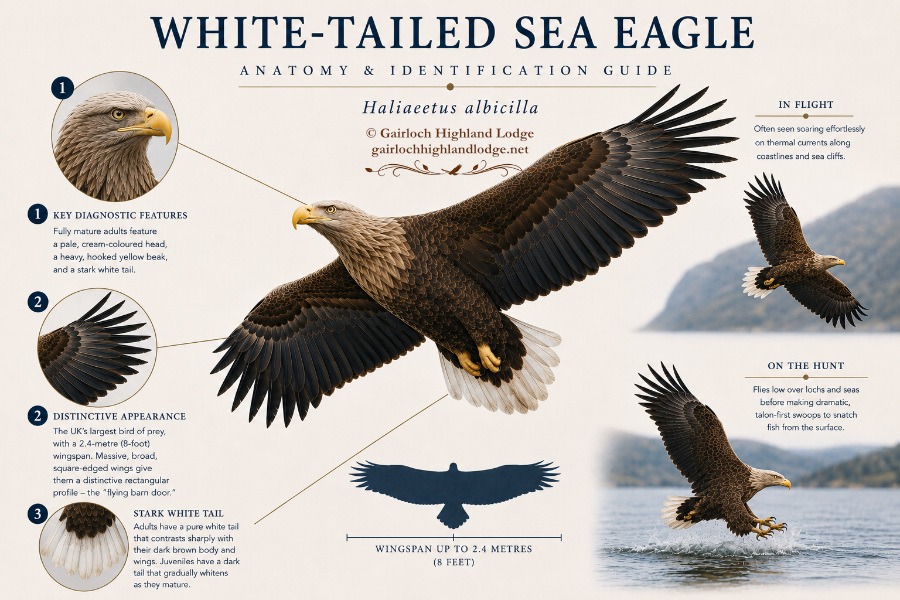
White-tailed Sea Eagle (Haliaeetus albicilla)
Distinctive Appearance: The UK’s largest bird of prey, boasting an incredible 2.4-metre (8-foot) wingspan. Their massive, broad, square-edged wings give them a distinctively rectangular profile in the air. This has earned them the famous nickname “the flying barn door.”
Key Diagnostic Features: Fully mature adults feature a pale, cream-coloured head, a heavy, hooked yellow beak, and a stark white tail.
In Flight & On the Hunt: Look for them soaring effortlessly on thermal currents along sea cliffs. Alternatively, flying low over lochs before making dramatic, talon-first swoops to snatch fish right off the surface.
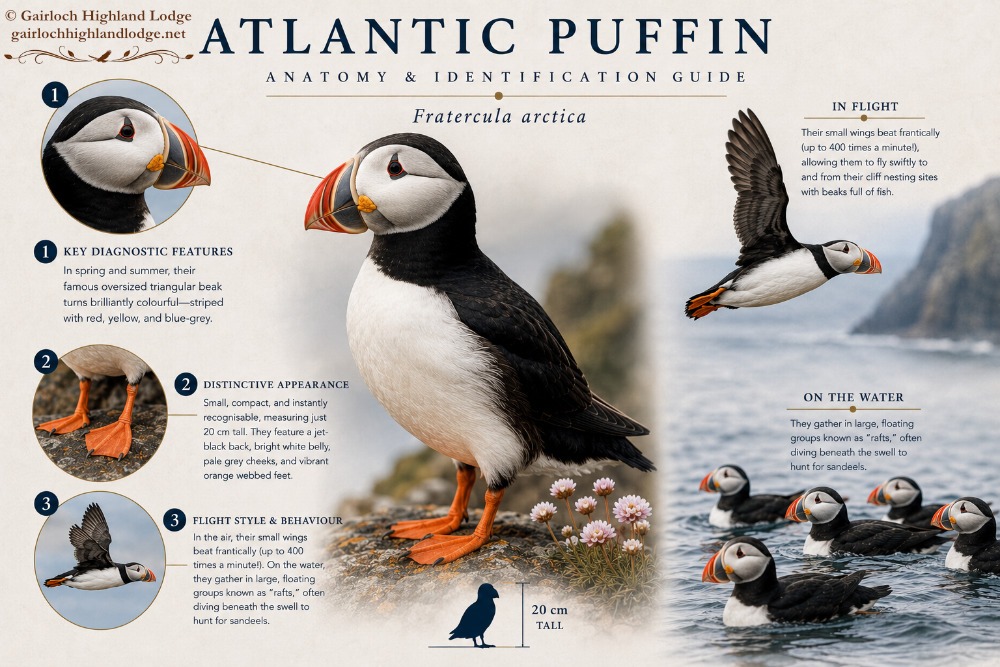
Atlantic Puffin (Fratercula arctica)
Distinctive Appearance: Small, compact, and instantly recognisable, measuring just 20 cm tall. They feature a jet-black back, white belly, and vibrant orange webbed feet.
Key Diagnostic Features: During spring and summer, they display their famous, oversized triangular beak—striped with brilliant red, yellow, and blue-grey.
Did You Know? (Seasonal Shape-Shifters): After the breeding season ends in late summer, puffins shed the bright outer plates of their beak. Out in the open ocean during autumn and winter, their beak shrinks and turns a dull greyish-brown, while their bright white face darkens to a dusky grey.
Flight Style & Behaviour: In the air, their small wings beat frantically (up to 400 times a minute!). On the water, they gather in large, floating groups known as “rafts,” often diving beneath the swell to hunt for sandeels.
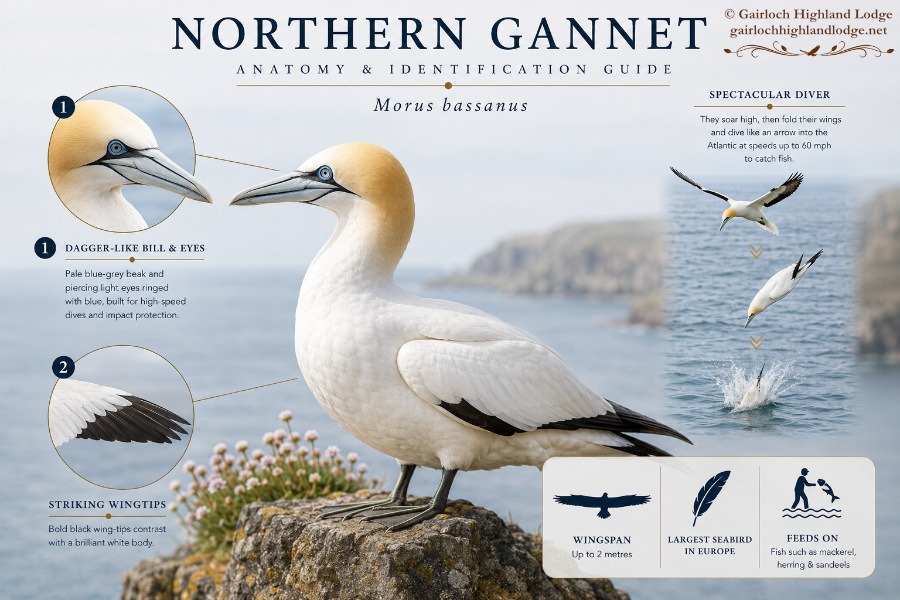
Northern Gannet (Morus bassanus)
Distinctive Appearance: Europe’s largest seabird, with an impressive 2-metre wingspan. They have a sleek, bright white body, striking black wingtips, and a soft yellow-buff wash across their head and neck.
Key Diagnostic Features: Dagger-like, pale blue-grey beaks and piercing light eyes ringed with blue. They are designed to absorb the impact of high-speed ocean entries.
Flight Style & Behaviour: Famous for their spectacular hunting technique. They circle high above fish shoals before folding their wings back into a narrow arrowhead, power-diving into the Atlantic at speeds of up to 60 mph!
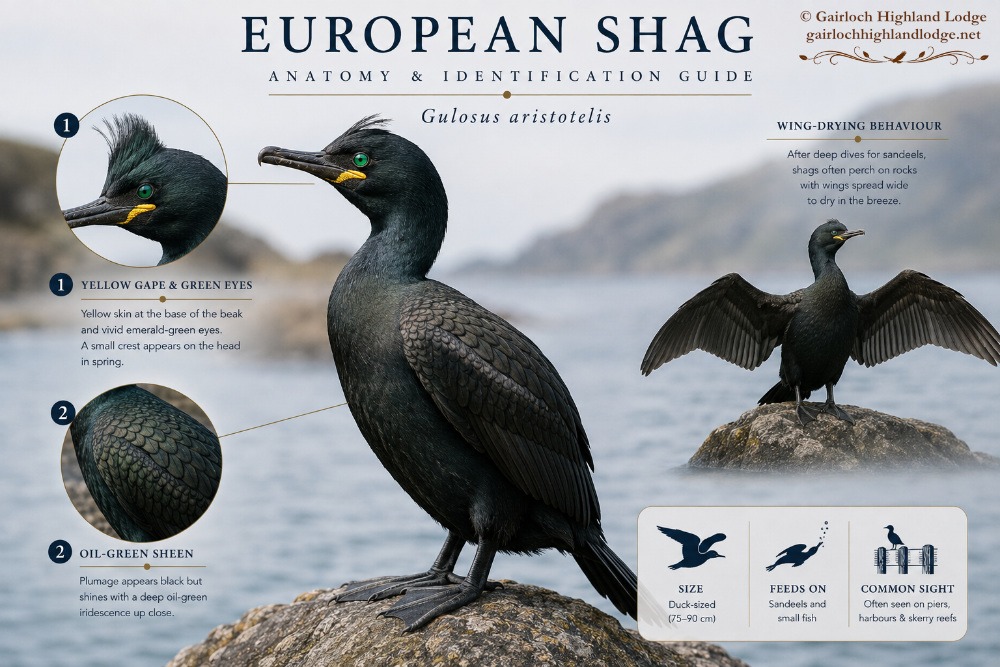
European Shag (Gulosus aristotelis)
Distinctive Appearance: Sleek, duck-sized, dark-bodied birds commonly seen sitting around Gairloch Harbour piers and skerry reefs.
Key Diagnostic Features: Up close, their plumage shines with a deep oil-green sheen. They have a yellow patch (gape) at the base of their beak. As well as vivid emerald-green eyes, and a small curved crest on their head during spring.
Flight Style & Behaviour: After deep feeding dives for sandeels, they regularly haul out onto rocks. Whereby, they hold their wings spread wide open to dry in the coastal breeze.
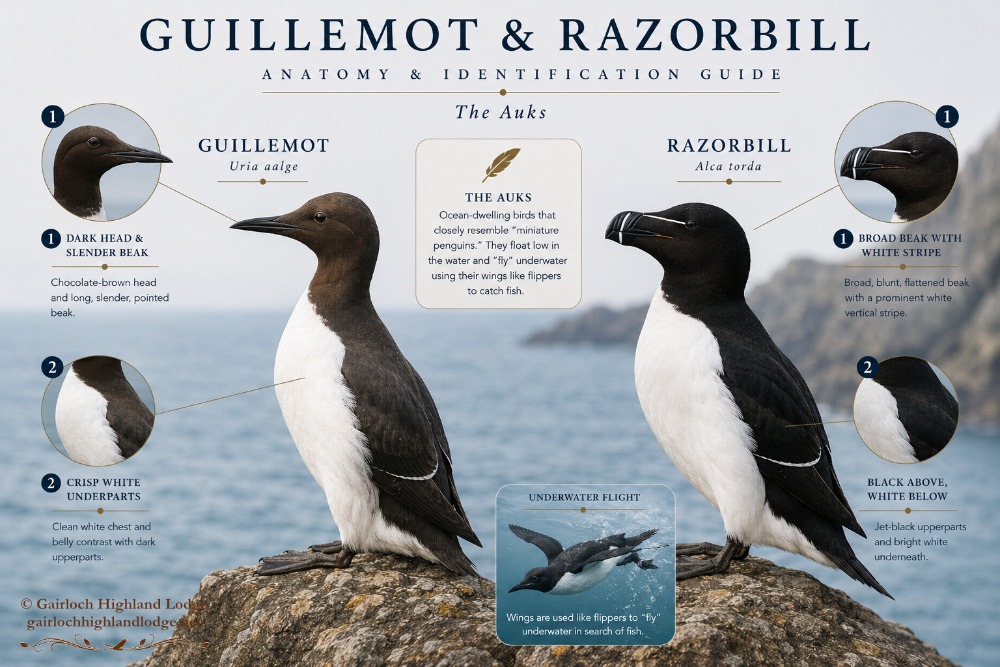
The Auk Family (Alcidae)
Distinctive Family Traits: Ocean-dwelling birds that closely resemble “miniature penguins.” Auks float low in the water and use their short, powerful wings like underwater flippers to “fly” through the sea in search of fish.
Atlantic Puffin (Fratercula arctica): The most famous auk! More details about Puffins are in the Puffin section above.
Common Guillemot (Uria aalge): Features a dark chocolate-brown head and back, a crisp white chest, and a long, slender, pointed beak.
Razorbill (Alca torda): Jet-black on top and white underneath, with a distinctly broad, blunt, flattened beak marked by a prominent white vertical stripe.
Black Guillemot / “Tystie” (Cepphus grylle): A local favourite found year-round around Gairloch Harbour piers and rocky shorelines. In summer, they sport striking soot-black plumage, brilliant white wing patches, and vivid bright red feet and inner mouth lining.
Fascinating Behaviours in The Minch
The waters of the Minch serve as a high-stakes arena where different species have evolved wildly different strategies to thrive. Whether diving from the clouds, swimming through the depths, or ruling the airwaves, the interaction between these species offers an unmissable spectacle.
High-Speed Diving vs. Deep Sub-Surface Chases: Few natural sights rival a Northern Gannet on the hunt. Spotting fish from up to 40 metres in the air, they lock their wings back into a aerodynamic dart, entering the water at speeds approaching 60 mph. Air sacs in their face and chest cushion the violent impact, allowing them to stun fish instantly. Beneath the surface, however, the Auk family rules. Puffins, Guillemots, and Razorbills effectively “fly” underwater using short, powerful wings, reaching depths over 60 metres to round up sandeels. Nearby, Shags execute a characteristic little jump off the water before dipping under, using their webbed feet to probe rocky reefs for bottom-dwelling prey.
Aerial Piracy & Eagle Swoops: At the top of the coastal food chain, the White-tailed Sea Eagle relies on sheer presence and tactical opportunism. While perfectly capable of swooping down to snatch live fish straight from the waves with heavy talons, they are also notorious for practicing kleptoparasitism. Such as harassing gannets, gulls, and otters until they drop their fresh catch.
Wing-Drying Rituals & Winter Camouflage: Unlike most seabirds, Shags do not produce abundant waterproofing oil on their feathers. This deliberate evolutionary trait allows them to sink rapidly with less buoyancy when diving deep, but it leaves them waterlogged afterward. Look out for them perched on exposed skerry rocks outside Gairloch Harbour, spreading their wings wide to dry in the wind. Meanwhile, as summer ends, the open ocean forces a radical change. Puffins shed the colorful outer plates of their beaks and trade their bright white faces for dusky grey plumage, spending the dark winter months entirely at sea in the open Atlantic.
When is Peak Season?
The absolute peak season for seabird watching around Gairloch runs from late April to early August. During these long spring and summer days, our coastal cliffs, sea stacks, and offshore islands burst into life as hundreds of thousands of birds arrive for the frantic breeding season. Spring is when adult puffins display their brilliant summer beaks. Additionally, local boat trips offer the highest chances of seeing rafted auks, plunge-diving gannets, and active sea eagles hunting to feed hungry chicks.
By mid-to-late August, the breeding colonies quieten down significantly as puffins, guillemots, and razorbills head back out into the open waters of the Atlantic. However, coastal birdwatching in Wester Ross is a year-round pleasure. Autumn and winter bring migrating wildfowl, divers, and waders to our sheltered sea lochs, while resident Black Guillemots (Tysties), Shags, and iconic White-tailed Sea Eagles remain local heroes along the Gairloch coastline all year long.
The Science: Ringing, GPS Tracking & Colony Health
Scientists and marine ornithologists, alongside conservation bodies like the RSPB, British Trust for Ornithology (BTO), and the Highland Ringing Group, meticulously study local bird populations to monitor both individual movements and the wider health of the Atlantic ecosystem:
GPS Telemetry & Eagle Territories: Many of the West Highland’s White-tailed Sea Eagles are fitted with lightweight, solar-powered satellite transmitters as chicks. Tracking data reveals that young eagles roam widely across Scotland for their first few years. However, adult breeding pairs establish strict, lifelong territories, returning to the exact same nesting eyries along the Wester Ross coast year after year.
Metal Ringing & Colour Flags: By fitting small, uniquely coded alloy rings (and readable colour flags) to the legs of seabirds like Puffins, Shags, and Auks, researchers can identify individual birds through telephoto lenses without recapture. This data has proved that puffins display remarkable nest-site tenacity—often returning to the exact same earthen burrow in successive summers after spending seven months alone in the open ocean.
Sentinel Species of the Minch: Seabirds are considered prime “bio-indicators” (barometers of ocean health). Long-term monitoring of breeding success, chick diet, and dive-depth tracking in the Minch provides scientists with crucial, real-time data. Including data on local sandeel stocks, sea surface temperature shifts, and the broader impacts of climate change on marine food webs.
Mindful Watching: Protecting Gairloch’s Avian Life
Watching coastal birds is a privilege. Seabirds use huge amounts of energy hunting and raising chicks during their short breeding season. Following a few simple guidelines ensures your encounters are safe and disturbance-free:
Keep Your Distance on Land: Stay 30–50 metres back from cliff edges, nesting colonies, and beach scrap nests. If a bird flushes, calls repeatedly, or swoops, you are too close. Stepping back protects exposed eggs and chicks from predators.
Keep Dogs Leashed: Keep dogs on a short lead along coastal paths, beaches, and grassy slopes from April to August. Ground-nesting birds, eiders, and puffin burrows are easily disturbed or trampled.
Boat & Paddleboard Etiquette: Keep a 50–100 metre distance from nesting stacks and floating “rafts” of seabirds. Slow down, pass around the outside of floating groups rather than cutting through them. Also avoid heading straight at perched sea eagles.
Use Optics: A good pair of binoculars or a zoom lens gives you front-row views without altering the bird’s natural behaviour.