The Orca (Orcinus orca), or Killer Whale, is the largest member of the dolphin family and one of the world’s most formidable apex predators. Reaching up to 9 metres in length for males and weighing as much as 6 tonnes. Orcas are highly intelligent marine mammals. They are not permanent residents of a single bay, but rather wide-ranging ocean wanderers.
Drawn to the waters around Gairloch and the Minch by deep-water drop-offs and seasonal abundances of prey—including seals, porpoises, and shoals of fish—their sudden appearance along our coastline is one of the most exhilarating wildlife spectacles in Northern Europe.
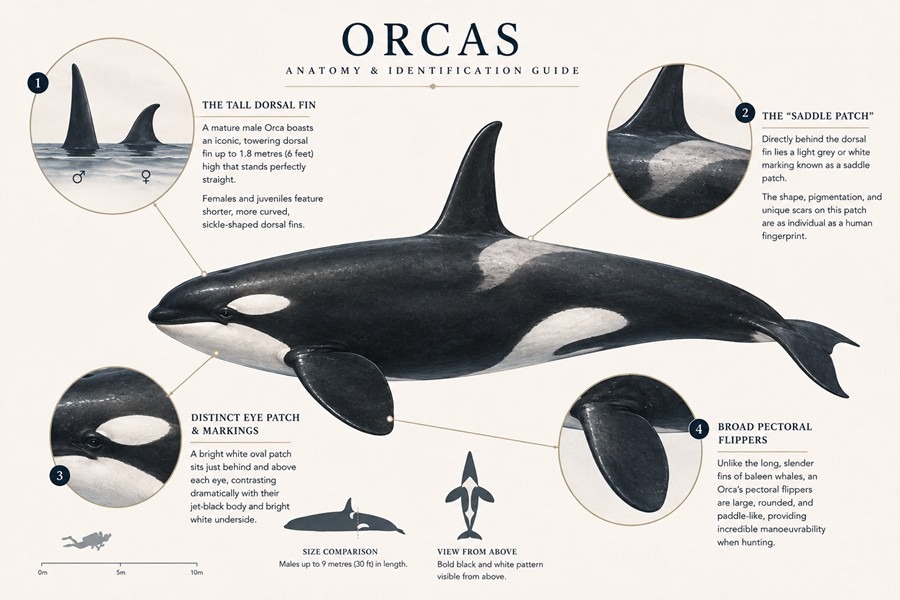
Anatomy & Identification Guide
When scanning the horizon, look for these distinctive, highly recognisable traits:
The Tall Dorsal Fin: A mature male Orca boasts an iconic, towering dorsal fin up to 1.8 metres (6 feet) high that stands perfectly straight. Females and juveniles feature shorter, more curved, sickle-shaped dorsal fins.
The “Saddle Patch”: Directly behind the dorsal fin lies a light grey or white marking known as a saddle patch. The shape, pigmentation, and unique scars on this patch are as individual as a human fingerprint.
Distinct Eye Patch & Markings: A bright white oval patch sits just behind and above each eye, contrasting dramatically with their jet-black body and bright white underside.
Broad Pectoral Flippers: Unlike the long, slender fins of baleen whales, an Orca’s pectoral flippers are large, rounded, and paddle-like, providing incredible manoeuvrability when hunting.
Fascinating Behaviours in The Minch
Orcas are renowned for complex social structures, communication, and coordinated hunting techniques:
Coordinated Pod Hunting: Orcas often hunt in tightly-knit family groups (pods). When targeting seals or porpoises near the shore, they work together in synchronised manoeuvres to corner prey against reefs or shallow coastlines.
Spy-hopping & Breaching: Highly curious and visual surface-behavers, Orcas frequently perform a “spy-hop”—lifting their heads vertically out of the water to inspect boats, sea cliffs, and coastlines—or execute full-body breaches.
Tail Slapping & Pod Vocalisations: Pod members communicate using underwater acoustic dialects unique to their family group, often accompanied by tail slaps (lobtail) at the surface to signal location or stun prey.
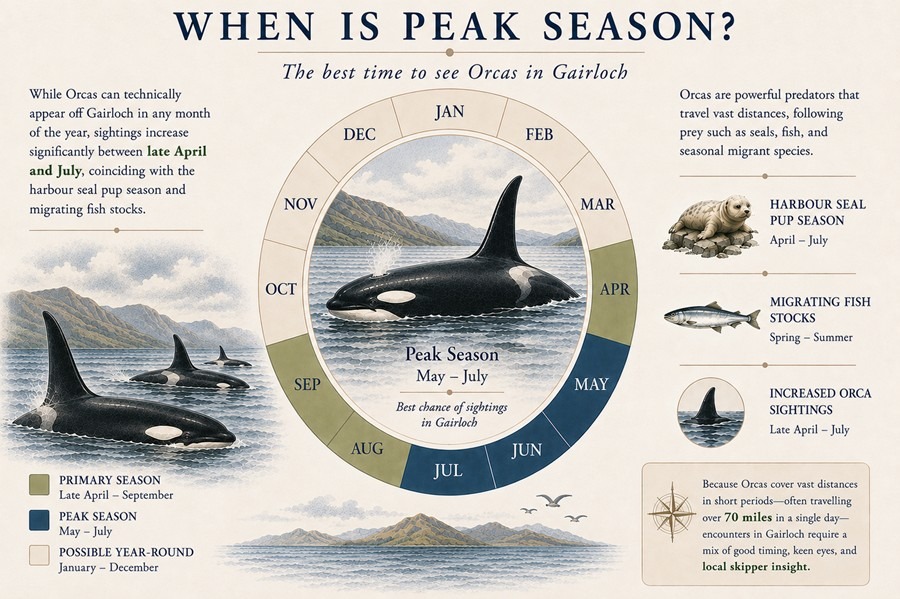
When is Peak Season?
While Orcas can technically appear off Gairloch in any month of the year, sightings increase significantly between late April and July, coinciding with the harbour seal pup season and migrating fish stocks.
Because Orcas cover vast distances in short periods—often travelling over 70 miles in a single day—encounters in Gairloch require a mix of good timing, keen eyes, and local skipper insight.
The Science: West Coast Community & Icelandic Visitors
Scotland’s waters are visited by distinct populations of Orca, tracked meticulously through photo-identification catalogues:
The West Coast Community: The UK’s only resident pod of Orcas. This unique, specialised group frequents the Hebrides and the West Coast. Distinctive for their sloping eye patches and larger size, they are sadly critically endangered, with only a few individuals remaining (including famous males “John Coan” and “Aquarius”).
Northern Isles & Icelandic Pods: In recent years, researchers have documented pods travelling from Iceland and Shetland down through the Minch during late spring and summer to feed on local seal colonies and mackerel shoals.
Conservation & Local Stewardship
As apex predators at the top of the marine food chain, Orcas face critical modern threats:
Bioaccumulation of Toxins: Legacy pollutants such as PCBs (polychlorinated biphenyls) accumulate in top predators, impacting reproductive health and immune systems across generations.
Prey Depletion & Marine Noise: Noise pollution from heavy maritime traffic can disrupt their echolocation and hunting communication.
Local advocacy groups, alongside research charities, continue to monitor pod health while raising awareness to protect the fragile marine ecosystem of Wester Ross.